Case Study: How a Custom Lampshade Studio Turned Room Saves Into Swatch Kit Orders
A composite Pinterest teardown of a made-to-order lampshade studio that replaced generic room inspiration with sizing and fabric decisions that led to more swatch-kit orders.
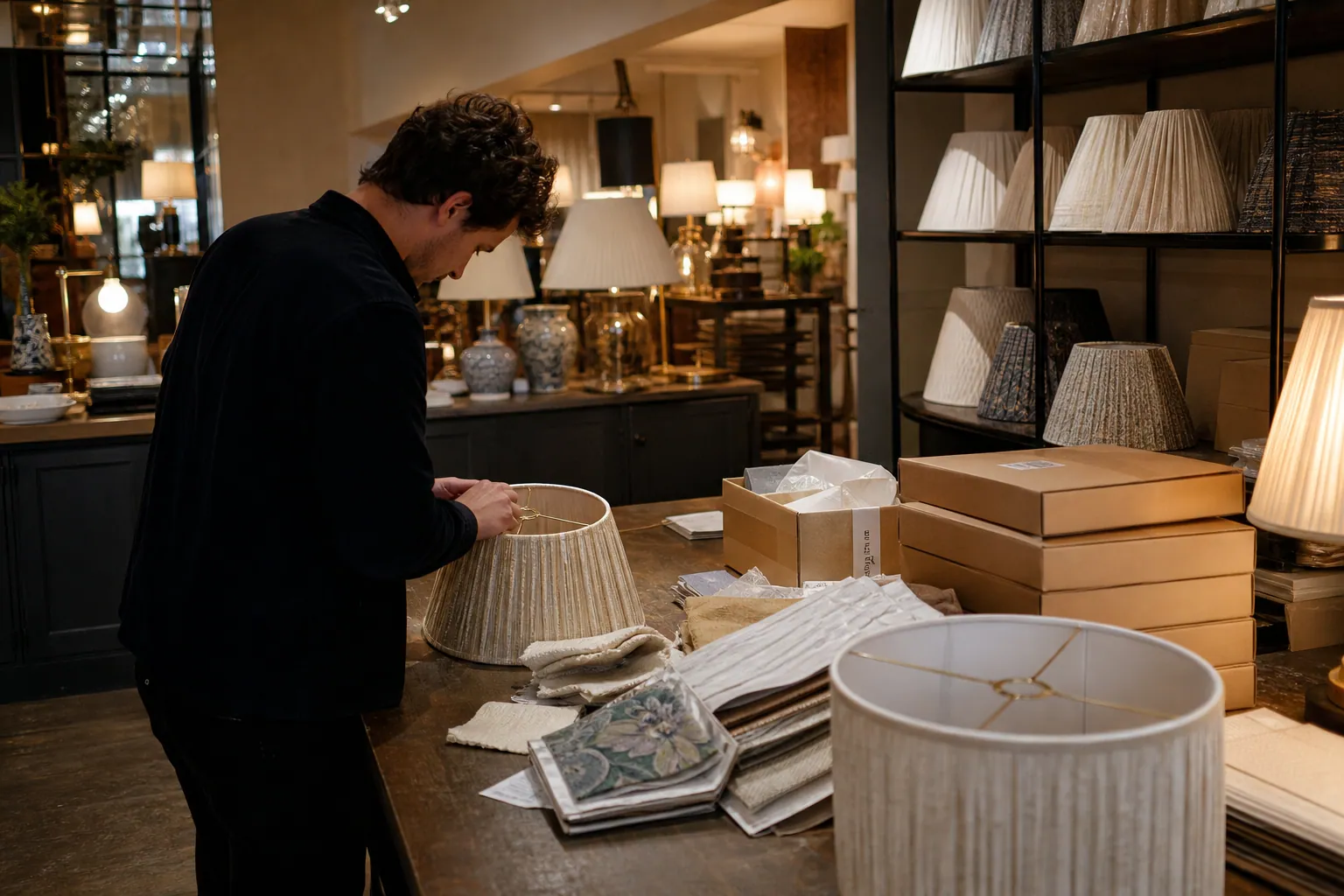
A made-to-order lampshade is difficult to buy from a beautiful room photo.
A shopper may save the photo because they like the room, then leave because they cannot tell whether the shade will fit their lamp, work with their nightstand, or suit their existing paint color. That gap was the central problem for this composite case study of a small custom lampshade studio.
The studio did not need more broad home-decor reach. It needed Pinterest visitors who were close to a practical decision: replace a dated shade, choose a diameter, compare fabrics, or order samples before committing.
This teardown shows how the team shifted from save-heavy room imagery to decision-led Pinterest content and used a swatch kit as the bridge to larger custom orders.
Note: This is a composite case based on recurring operator patterns. The business name and figures are illustrative, but the decisions, measurements, and operating approach are designed to be usable.
The baseline: attractive Pins, weak buying signals
The studio sold linen, pleated, and patterned lampshades in standard sizes, plus custom work for unusual lamp bases. Its average shade order was $285, and a $12 fabric swatch kit was credited toward a future shade purchase.
For three months, its Pinterest approach was mostly room photography:
- Neutral bedroom photos with a lampshade in the background
- Living-room before-and-after images
- Broad titles such as “Cozy Bedroom Lighting Ideas”
- Links to the homepage or a general shop collection
- Occasional product Pins with no sizing context
The account produced pleasing top-line activity. But the commercial path was thin.
| 90-day baseline metric | Result | What it actually meant |
|---|---|---|
| Saves | 3,860 | Strong decor inspiration, unclear purchase intent |
| Outbound clicks | 930 | Many visitors were curious, not yet confident enough to buy |
| Swatch kit orders from Pinterest-tagged sessions | 13 | The sample offer was largely invisible |
| Custom shade orders within 45 days | 5 | Too few visitors reached a decision-oriented page |
| Homepage share of Pinterest landing sessions | 61% | Visitors had to find sizing, fabric, and product options themselves |
The founder’s first instinct was to make more of the same room images because they had the highest saves. That would have doubled down on the wrong signal.
A save for “warm bedroom lighting” can be valuable for brand discovery. It is not equivalent to a person asking, “What size lampshade do I need for a bedside lamp?” The latter search has a specific next step the business can support.
The diagnosis: Pinterest was attracting a different job than the studio was solving
The team reviewed 40 top Pins and grouped them by what the viewer appeared to be trying to accomplish.
Three useful Pinterest search-intent clusters emerged:
- Replacement and fit: “replace lamp shade,” “what size lampshade for table lamp,” and “lamp shade harp size.”
- Room coordination: “linen lampshade bedroom,” “blue bedroom lamp shade,” and “traditional lampshade living room.”
- Custom constraints: “odd size lampshade,” “shade for vintage lamp,” and “custom pleated lampshade.”
The existing Pins mostly served a fourth, lower-commercial-intent group: broad room inspiration.
That finding changed the brief. Instead of asking, “Which room photo should we publish this week?” the studio asked:
- What must a buyer know before ordering?
- Which uncertainty is stopping them from ordering a swatch kit?
- Which destination can answer that question without sending them through five collection pages?
This distinction matters for Pinterest SEO. Pin titles and descriptions should identify the decision the Pin helps with, while the landing page has to finish the job.
The rebuild started with three destinations, not more Pins
The studio created three durable Pinterest landing pages before redesigning its creative.
1. The bedside lampshade sizing guide
This was a visual guide showing how to measure a lamp base, harp, and nightstand. It used plain-language examples rather than universal rules:
- A 16-inch drum shade on a 28-inch-wide nightstand
- A 10-inch shade for a smaller reading lamp
- How a tall, narrow base changes the preferred shade proportion
- When to request help for vintage or unusual fittings
Each section pointed to matching ready-to-order sizes, then offered the swatch kit for customers deciding on fabric.
The point was not to turn Pinterest into a lamp-engineering classroom. It was to make a shopper feel capable of taking the next correct step.
2. The fabric-and-room-color sample page
The old collection pages showed fabrics, but they did not explain why someone should order samples before buying.
The new page grouped fabrics by decision context:
- Warm whites and flax linens for cream or wood-heavy rooms
- Blue and green patterns for painted bedrooms
- Textured neutrals for rental-friendly refreshes
- More opaque fabrics for a softer bedside glow
It also clearly stated the sample-kit price, credit policy, dispatch time, and what the buyer receives. The team stopped treating samples as a buried add-on and positioned them as a low-risk design step.
3. The custom-shade inquiry page
The custom page had one role: qualify unusual requests without promising an instant quote.
Its form requested:
- Base and existing-shade measurements
- Photos of the fitter and lamp base
- Desired fabric direction
- Room and deadline details
This page was linked only from Pins addressing non-standard dimensions, vintage lamps, and custom pleating. It was not used as a catch-all destination for every decor Pin.
What the new Pins looked like
The studio kept some styled rooms, but each one had a job. Every Pin belonged to one of three creative families.
| Pin family | Example Pin title | Destination | Primary action |
|---|---|---|---|
| Measurement | “How to Choose a Bedside Lampshade Size” | Sizing guide | View suitable sizes or order samples |
| Coordination | “Linen Lampshade Ideas for a Blue Bedroom” | Fabric-and-room-color page | Order a swatch kit |
| Constraint | “Replacing a Lampshade on a Vintage Table Lamp” | Custom inquiry page | Submit measurements and photos |
The visual changes were equally important.
Measurement Pins used an actual lamp, tape measure, and simple labels. The text overlay called out one useful answer, such as “Measure the base width before choosing shade diameter.”
Coordination Pins used a styled scene, but the shade was large enough to inspect. A small caption identified the fabric and room color instead of relying on a vague “shop the look” prompt.
Constraint Pins showed the underside of a shade, fitter type, and lamp hardware. These images were less glamorous, but they earned clicks from people who had a real compatibility problem.
The team wrote Pinterest pin titles around the decision first and the product second. For example:
- “Table Lamp Shade Size Guide for Bedside Tables”
- “Blue Bedroom Lampshade Ideas: Linen and Patterned Fabrics”
- “How to Replace an Old Lampshade Without Replacing the Lamp”
Descriptions added relevant detail—fabric type, measurement reminder, and destination—but did not repeat the title with a string of keywords.
The small operational change that prevented bad Pins
Made-to-order retail has a common Pinterest problem: a Pin can keep circulating after a fabric is discontinued or a lead time changes.
The founder added a simple approval row to the weekly content sheet:
| Check before publishing | Owner |
|---|---|
| Fabric is available for at least six weeks | Production lead |
| Lead time is current | Founder |
| Measurements and fitter claims are accurate | Product specialist |
| Landing page has the matching fabric or guide | Ecommerce lead |
| UTM values are applied | Marketing owner |
This took less than 10 minutes per batch and avoided a costly pattern: Pinterest traffic arriving on a beautiful but unavailable fabric.
The team used a shared content queue to store the Pin image, title, destination, availability check, and UTM string. A lightweight platform such as PinPinMe can help keep those publishing details and approved assets together when a small team is managing many creative variations.
How the studio measured the result without over-crediting Pinterest
A custom shade can take weeks from first click to purchase. Measuring only same-session ecommerce revenue would undervalue discovery content; measuring saves alone would overvalue it.
The studio adopted two rules:
- Keep each intent cluster in its own UTM campaign.
- Review sample-kit orders and shade orders on a 45-day lag.
One UTM pattern looked like this:
utm_source=pinterest
utm_medium=organic
utm_campaign=bedside-shade-sizing
utm_content=measurement-diagram-01
The dashboard included both leading and downstream signals:
- Outbound clicks by Pin family
- Landing-page views and sample-kit conversion rate
- Swatch kit orders by campaign
- Percentage of sample buyers who used the credit
- Custom inquiry completion rate
- Shade revenue within 45 days of a Pinterest-tagged first visit
- Refunds or remake reasons, especially fit-related ones
That last measure mattered. A growth strategy that sells the wrong-size shade is not durable growth.
What changed over the next 12 weeks
The studio published 24 new Pins: eight sizing Pins, ten fabric-and-room Pins, and six custom-constraint Pins. It did not delete every old room Pin, but it stopped boosting its broadest creative with more production time.
Here is the composite outcome compared with the previous 90-day period.
| Metric | Before | After | Interpretation |
|---|---|---|---|
| Saves | 3,860 | 2,740 | Fewer casual decor saves, which was acceptable |
| Outbound clicks | 930 | 1,290 | Better match between Pin promise and next-step page |
| Swatch kit orders | 13 | 47 | The sample offer became a visible decision step |
| Shade orders within 45 days | 5 | 17 | More visitors arrived with fit or fabric context |
| Custom inquiry completion rate | 18% | 31% | The form and Pins better matched unusual requests |
| Fit-related remake requests | 4 | 2 | Sizing content improved expectation-setting |
The top Pin by saves was still a styled bedroom scene. But the highest-value Pin was a plain measurement diagram titled “What Size Lampshade for a Bedside Lamp?”
It generated fewer saves than the decor image and more swatch kit orders per 100 outbound clicks. That was the content to scale.
Decisions the studio deliberately did not make
A good case study should show restraint, not just activity.
The team did not:
- Create a separate board for every fabric color
- Send every visitor to a generic email pop-up
- Use AI-generated rooms that made shade proportions unreliable
- Promote custom work with fixed price claims before seeing measurements
- Treat Pinterest attribution as proof that Pinterest alone caused every order
- Turn every Pin into a product grid
Instead, it used broad room imagery as an entry point only when the Pin led to a useful fabric or proportion decision.
Transferable lessons for high-consideration ecommerce brands
The lesson is not “every retailer should sell swatch kits.” It is that Pinterest works better when a visual business identifies the uncertainty between inspiration and purchase.
1. Find the pre-purchase question
For lampshades, it was size and fabric. For another business, it may be compatibility, materials, care, color matching, delivery access, or installation.
List the questions your support inbox receives before making more content. Those questions are often more commercially useful than broad category keywords.
2. Match each Pin to one next decision
A Pin about sizing should not land on a homepage. A Pin about colors should not require a shopper to first learn how fittings work.
Create Pinterest landing pages that answer the promise made in the visual and lead naturally toward the product, sample, consult, or quote.
3. Treat low-commitment offers as products, not distractions
The swatch kit worked because it reduced risk and had a clear relationship to the final order. It was not a generic discount or a detached downloadable freebie.
If you offer samples, consultations, calculators, fit quizzes, or material guides, give them dedicated pages and track whether they lead to revenue.
4. Let saves be a diagnostic, not the finish line
Pinterest saves can tell you that an image is aspirational or useful. They do not tell you whether the image attracted your buyer, answered the right question, or reached a page that can convert.
Compare saves with outbound clicks, downstream actions, and delayed order cohorts before declaring a creative winner.
5. Build a content check around operational truth
For made-to-order brands, inaccurate lead times, unavailable materials, and misleading proportions can create more work than revenue. A short availability and accuracy review protects both customer experience and Pinterest performance.
The lampshade studio grew not by abandoning room inspiration, but by making inspiration useful at the moment a buyer needed to choose. That is the shift worth applying: publish fewer vague promises, and more content that helps a real customer make the next decision with confidence.
Case Study: How a Pond Kit Shop Turned Waterfall Saves Into Kit Orders
A composite Pinterest teardown of a backyard pond retailer that replaced pretty-waterfall traffic with sizing, planning, and kit-selection content that produced stronger carts.
Case Study: How a Garage Floor Coating Contractor Turned Pinterest Saves Into Site Visits
A composite teardown of a garage floor coating company that traded broad inspiration Pins for planning content, local pages, and more estimate-ready Pinterest traffic.

Case Study: Which Pinterest Pins Sold Custom Address Stamps—Wedding, Moving, or Gift Guides?
A composite case study of a custom address-stamp shop comparing product Pins, wedding content, moving guides, and gift pages to find a profitable Pinterest mix.
Case Study: How an Etsy Product Photography Course Turned Styling Saves Into Evergreen Enrollments
A composite teardown of a product photography educator who replaced generic styling inspiration with decision-led Pinterest content that produced better leads and course sales.

Case Study: A Cottage Food Course’s Pinterest Shift From Recipe Saves to Enrollments
A composite teardown of a cottage food educator who replaced recipe-heavy Pins with compliance, pricing, and preorder content that produced more course-ready leads.

Case Study: How a Photographer Template Shop Turned Free Welcome Guides Into Bundle Sales
A composite Pinterest funnel teardown for Canva template sellers who need fewer freebie collectors and more purchases of client-guide, pricing, and mini-session bundles.